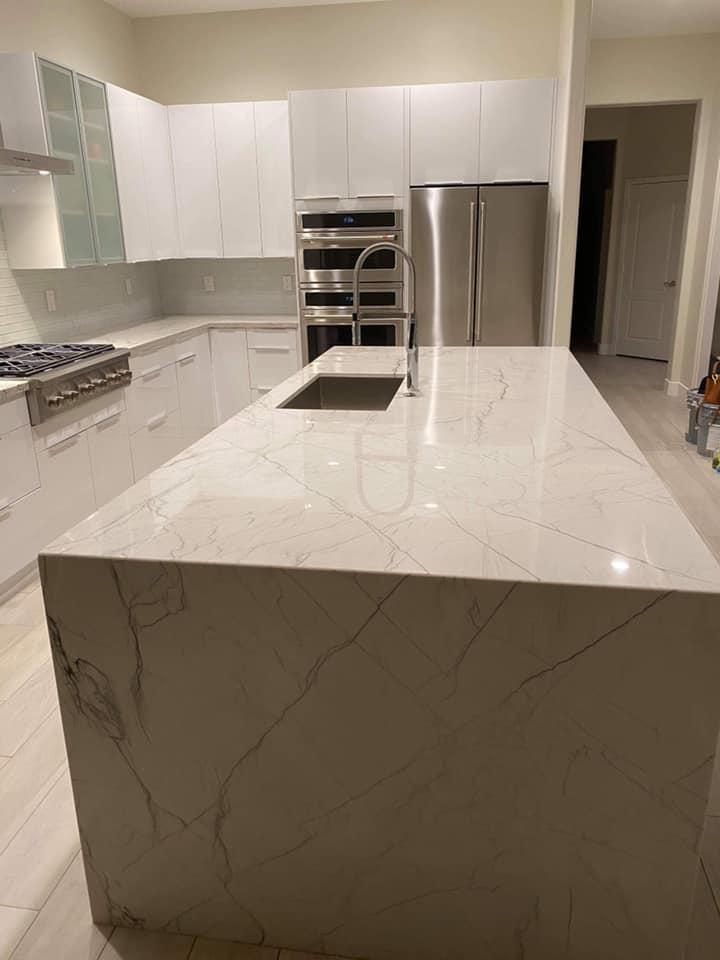
When Mesa homeowners start shopping for premium kitchen countertops, two natural stones consistently rise to the top of the list: quartzite and granite. Both are beautiful, durable, and add undeniable value to a home. But they're not interchangeable — each has distinct characteristics that make it better suited for different kitchens, lifestyles, and design preferences.
After installing more than a thousand granite and quartzite countertops across the East Valley, Red Baron Construction has deep experience with both materials. Here's an honest, side-by-side comparison to help you make the right choice for your kitchen.
How They're Formed
Understanding how each stone forms explains many of their differences. Granite is an igneous rock, created when molten magma cools slowly deep beneath the earth's surface. This slow cooling process produces the visible mineral crystals — feldspar, quartz, and mica — that give granite its characteristic speckled appearance.
Quartzite, on the other hand, is a metamorphic rock. It starts as sandstone, which is then subjected to extreme heat and pressure over millions of years, fusing the sand grains into an incredibly hard, dense stone. This process creates the sweeping veins and translucent quality that make quartzite so visually striking.
Hardness and Durability
This is where quartzite has a clear advantage. On the Mohs hardness scale, quartzite rates a 7 — harder than granite (which typically falls between 6 and 6.5) and harder than glass and steel. In practical terms, quartzite is more resistant to scratching from everyday kitchen use. You can chop vegetables directly on a quartzite countertop without leaving a mark, though we still recommend using cutting boards to keep your knives sharp.
Both stones handle heat exceptionally well. You can set a hot pot on either surface without damage — something that can't be said for many engineered countertop materials. For Arizona kitchens that open to outdoor cooking areas, quartzite's superior UV resistance makes it the better choice for countertops that receive direct sunlight, as granite can fade slightly over years of sun exposure.
Appearance and Aesthetics
This category comes down to personal preference, and both stones offer stunning options. Granite delivers a wide spectrum of colors and patterns: deep blacks (Absolute Black, Black Galaxy), warm browns and golds (Giallo Ornamentale, Typhoon Bordeaux), dramatic blues (Blue Bahia, Azul Macaubas), and classic whites (Bianco Antico, Colonial White). Granite's pattern tends to be more granular and distributed, with movement that's busy and interesting up close.
Quartzite tends to produce longer, more dramatic veining — similar in appearance to marble but far more durable. Popular quartzite varieties like Taj Mahal (soft gold and cream veins), Calacatta Lux (white with bold gray veins), and Patagonia (dramatic gold, burgundy, and cream) have become some of the most sought-after countertop materials in the high-end market. If you love the look of marble but want a stone that can handle a busy kitchen, quartzite is the answer.
Maintenance and Sealing
Both granite and quartzite are natural stones that benefit from periodic sealing, but the maintenance requirements differ. Most granites should be sealed once a year — a simple process that takes about 15 minutes. Well-sealed granite resists stains effectively, though acidic liquids like red wine or lemon juice should still be wiped up promptly.
Quartzite is naturally denser and less porous than most granites, which means it absorbs less liquid and is more stain-resistant even before sealing. We still recommend sealing quartzite countertops annually as a precaution, but in practice, quartzite is more forgiving of the occasional spill that sits a bit too long.
Cost Comparison
Granite is generally the more budget-friendly option. Entry-level granite slabs start around $40 per square foot installed, while mid-range and premium varieties range from $60 to $100 per square foot. Exotic granites with rare colors or patterns can exceed $120 per square foot.
Quartzite is positioned at the premium end of the market. Most quartzite slabs fall between $80 and $150 per square foot installed, with the most exotic varieties reaching $200 or more. The higher cost reflects quartzite's superior hardness, its dramatic aesthetics, and the more labor-intensive fabrication process — cutting and polishing quartzite requires specialized diamond tooling due to its extreme density.
Which Should You Choose?
Choose granite if you want a beautiful natural stone with the widest range of color options, excellent durability, and a more accessible price point. Granite is a proven performer that has been the countertop of choice in American kitchens for decades, and it remains an outstanding value.
Choose quartzite if you prioritize scratch resistance, want the marble-like aesthetic with superior durability, have countertops exposed to direct sunlight, or simply want the hardest natural stone available for your kitchen. Quartzite is the choice for homeowners who want the absolute best and are willing to invest in it.
See Both Stones in Person
The best way to choose between granite and quartzite is to see and touch the actual slabs. Red Baron Construction accompanies every client to local stone yards where you can compare options side by side, feel the surface textures, and see how different stones look under natural light. We provide expert guidance on which materials work best with your cabinetry, flooring, and design vision — all backed by 24 years of installation experience. Call us at (480) 628-8972 or visit our contact page to schedule your free consultation.
Get Your Free Estimate
Ready to transform your kitchen or bathroom? Contact Red Baron Construction for a free in-home consultation.